Vanuatu Among the Pacific Passports
Within the Pacific the picture reverses: Vanuatu outranks most of the region on travel access.
When you hear "Pacific passport ranking," it's a reference to the power of passports from nations like Australia, New Zealand, and their island neighbors. How do they stack up? As of early 2026, Australia and New Zealand are global heavyweights, consistently landing in the top 10. This isn't just a number; it means their citizens can enter over 185 countries without getting a visa beforehand, a freedom measured by private firms through global mobility indexes like Henley's. For the average traveler, this translates into spontaneous trips and fewer bureaucratic headaches.
While these rankings are about mobility, the core right to even hold a passport and leave your country is a serious legal principle. It's a fundamental freedom, protected by international standards like Article 2 § 2 of Protocol No. 4 to the European Convention on Human Rights—a benchmark that has shaped modern ideas on freedom of movement across the globe.
What Determines a Passport's Power?
A passport's muscle is its "mobility score." Simply put, this is the number of places you can go without a pre-approved visa. It's a complex dance of diplomacy, economics, and trust. The score counts visa-free travel, but also includes visa-on-arrival options and simple electronic travel authorizations (eTAs). Several factors decide how high that score climbs.
Visa-Free Access: The bedrock of it all. The more countries that welcome a passport holder without a pre-arranged visa, the better the rank. These agreements are almost always reciprocal, acting as a barometer for the diplomatic health between two nations.
Economic & Diplomatic Relations: A country's reputation matters. Nations with stable governments, strong trade pacts, and a positive global image find it much easier to negotiate visa-waiver deals for their people.
Regional Blocs: Membership in a powerful club can supercharge a passport. Look at the European Union. Its passports grant sweeping travel rights across the Schengen Area. In the Pacific, the Trans-Tasman Travel Arrangement between Australia and New Zealand gives their citizens an almost unique right to live and work in either country—a level of integration few other nations share.
Security & Vetting Standards: How secure is the document itself? International trust hinges on a country's ability to prevent fraud. Organizations like INTERPOL help with tools like the Stolen and Lost Travel Documents (SLTD) database. A country known for lax security or poor data sharing will find other nations hesitant to grant its citizens visa-free entry, as the risk is just too high.
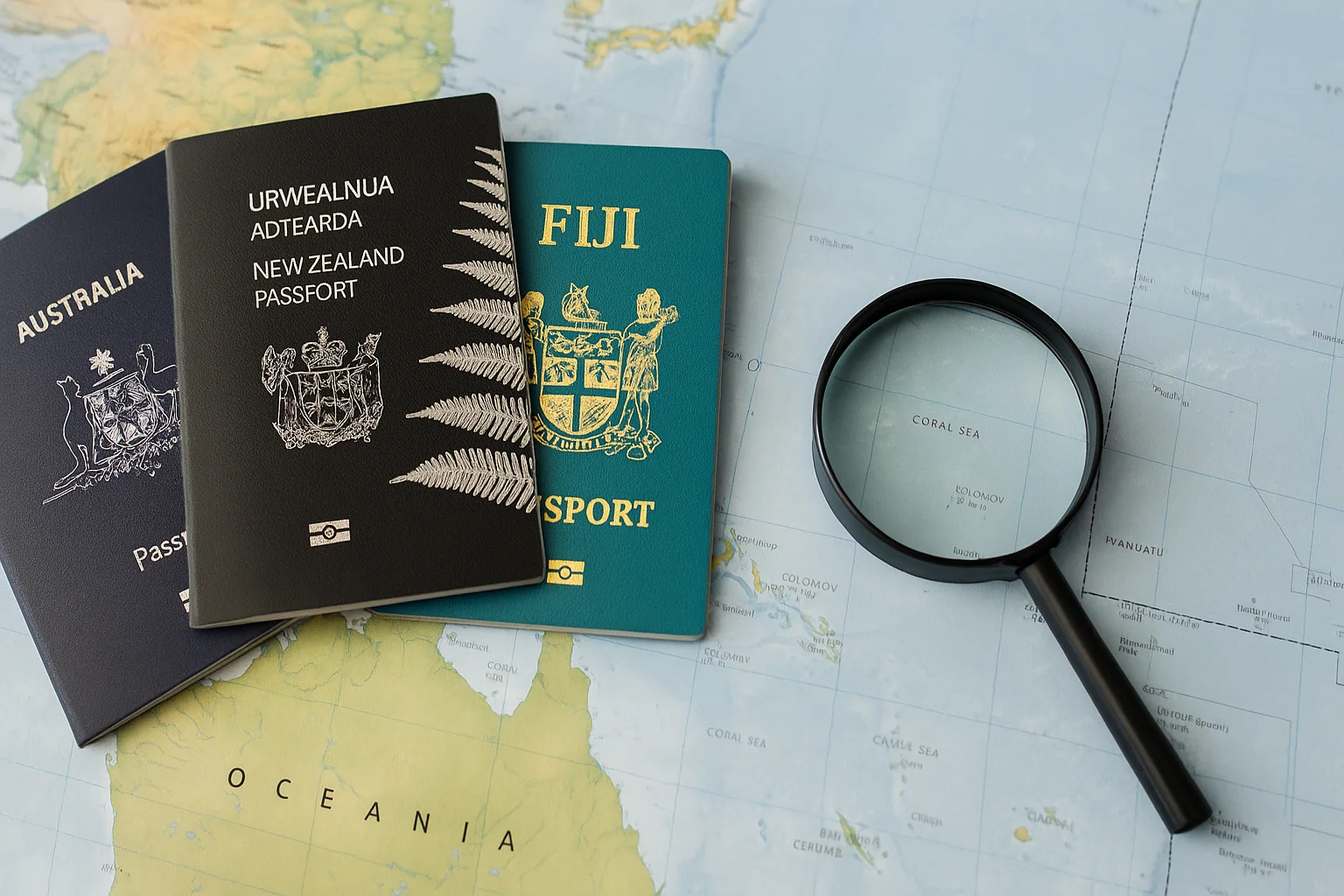
How Do Major Pacific Passports Rank in 2026?
In 2026, the Pacific's passport landscape is tiered. Australia and New Zealand sit firmly at the top. Below them, a diverse group of Pacific Island nations offers varying degrees of global access.
Australia and New Zealand: The Regional Powerhouses
Both Australian and New Zealand passports are regulars in the global top 10. For their holders, this means visa-free or visa-on-arrival access to over 185 destinations. That's not just a statistic; it means seamless entry into the world's most critical hubs for business and leisure:
- Europe: The entire Schengen Area is open for business and holidays, visa-free.
- North America: A quick online application gets you into the United States (via ESTA) or Canada (via its eTA program).
- United Kingdom: Long-standing agreements ensure hassle-free travel.
And then there's the unique Trans-Tasman Travel Arrangement. It creates a largely integrated zone, meaning an Aussie can move to Auckland for a job with nearly the same ease as moving from Sydney to Melbourne.
Pacific Island Countries: A Mixed Picture
For island countries in the pacific like Fiji, Samoa, Tonga, and Vanuatu, the story is more varied. Their mobility scores don't reach the heights of Australia or New Zealand; a Fijian passport, for instance, provides access to about 80-90 destinations. But here's the interesting part: these passports can have unique advantages. Thanks to specific diplomatic ties, they may offer visa-free access to countries like China or Russia—a privilege even some top-tier passport holders don't have. These specific agreements are often hammered out through forums like the Pacific Summit, showing the power of regional cooperation.
Comparison Table: Pacific vs. Other Major Passports
| Passport | Typical Rank (Global) | Approx. Visa-Free Destinations | Key Access Areas | Distinguishing Feature |
|---|---|---|---|---|
| Australia | Top 10 | 185+ | Schengen, UK, US (ESTA) | Trans-Tasman Travel Arrangement |
| New Zealand | Top 10 | 185+ | Schengen, UK, US (ESTA) | Trans-Tasman Travel Arrangement |
| Fiji | ~60-70 | 80-90 | Pacific Nations, parts of Asia | Niche visa waivers (e.g., China). |
| US Passport | Top 10 | 185+ | Schengen, UK, Japan | Requires visas for some countries others can access freely (e.g., Brazil, China). |
| Canadian Passport | Top 10 | 185+ | Schengen, UK, US (visa-free) | Strong, stable access similar to Australia/NZ. |
Takeaway: While Australia and New Zealand offer world-class mobility, some Pacific Island passports provide surprisingly strategic, if more limited, travel advantages based on their own unique diplomatic histories.
What Legal Rights Are Attached to a Passport?
A passport is much more than a travel document. It's the key to exercising your fundamental human right to leave your own country. This isn't just a nice idea; it's a right solidified in international law and backed by major court decisions.

International Law Precedent
The idea that a government can't just arbitrarily deny you a passport is a pillar of modern human rights. The European Court of Human Rights (ECHR), a globally influential body, has been clear on this.
Landmark cases like Bartik v. Russia (application no. 55565/00) cemented the rule. The Court found that refusing to issue a passport is a direct violation of the right to leave one's country, as spelled out in Article 2 § 2 of Protocol No. 4 of the ECHR. This protects your ability to travel for work, family, or any other reason. Later, in Battista v. Italy (application no. 43978/09), the Court doubled down, confirming that passport denial is an official interference with your freedom of movement.
Lawful Limitations on Passport Rights
Still, this right isn't absolute. Governments can legally restrict your passport, but the hurdles are high. Any refusal must be:
- Provided for by law: The reason can't be made up on the spot; it must be grounded in an existing national law.
- For a legitimate purpose: National security, public safety, preventing a criminal from fleeing, or ensuring someone pays child support are common legitimate reasons.
- Necessary and proportionate: The restriction must be the smallest possible measure to achieve the goal. A permanent, blanket travel ban for a minor issue would almost certainly be struck down in court as disproportionate. This final point is crucial—it's the check that ensures governments can't abuse their power and provides a legal avenue for citizens to challenge an unfair denial.
These safeguards are what keep passport issuance a right, not a privilege, and prevent governments from using it as a tool for punishment or political control.
What Are the Practical Differences Between a Passport and a Passport Card?
They are both official government IDs, but a passport book and a passport card are not interchangeable. They serve very different functions. The US system offers the clearest example of how this works.

The US Passport Card: A Limited-Use Document
Think of the US passport card as a specialized tool. It's a wallet-sized ID designed for people who frequently cross specific borders by land or sea. Its use case is extremely narrow:
- Where it works: At land border crossings and sea ports-of-entry from Canada, Mexico, the Caribbean, and Bermuda.
- Where it absolutely does NOT work: For any international air travel. Ever. A traditional passport book is mandatory if you're getting on a plane to or from the United States.
Cost and Convenience Comparison
So why get one? Portability and price. The passport cost for a card is significantly lower—a US adult card costs less than half the price of a full passport book. For someone living in a border town who crosses into Canada for weekly shopping, it's a cheap and convenient option to keep in their wallet.
Context in the Pacific Region
Here's the critical part: the passport card system is a North American invention. It is not a feature of international travel in the Pacific. If you are flying between Australia, New Zealand, Fiji, or any other Pacific island, you need a full passport book. No exceptions. Showing up at the airport with a passport card equivalent would get you denied boarding, full stop.
How Can I Maximize My Travel Freedom?
For those looking to boost their global mobility, the strategies are varied. They range from simple document organization all the way to complex citizenship planning. At its core, the goal is always the same: reduce friction, and maximize access.
Practical Steps for Every Traveler
- Keep Documents Current: The single biggest travel headache? An expired passport. It happens more than you think. Many countries require your passport to be valid for at least six months from your planned departure date from their country—a detail that trips up countless travelers. Before any travel, ensure your passport is valid by checking that date. If it's cutting it close, start the renewal process immediately, as it can take months.
- Understand Visa Policies: Don't even think about booking a flight until you've researched the visa requirements for your destination. This depends entirely on your citizenship. The only reliable sources are the official embassy and consulate websites. Remember, even seemingly simple rules for visas-on-arrival or eTAs can change without warning, so check right before you travel, not just when you're planning.
- Adhere to Photo Requirements: A bad photo is one of the top reasons passport applications get rejected. Seriously. Every country has its own rigid passport photo requirements for size, background color, and even your facial expression. Submitting a photo that doesn't meet these exact specifications can send your application to the back of the line, causing delays that could derail your entire trip.
Advanced Strategies for Global Citizens
For high-net-worth individuals or anyone seeking ultimate travel freedom, a second citizenship is a game-changing strategy. Programs like Citizenship by Investment (CBI) and Residency by Investment (RBI) offer a direct path to a second, often stronger, passport. You'll find established programs in several countries, especially in the Caribbean and Europe. This can radically expand your visa-free access and, just as important, provides a solid "Plan B" in a deeply uncertain world.
This article is published by an independent law firm for informational purposes only and does not represent or claim affiliation with any government body, international organization, or official authority.
Questions
Frequently Asked Questions
While the rankings shift each quarter, the most powerful passports consistently belong to a small club of nations: Singapore, Japan, Germany, Spain, Italy, and France. In any given year, the top three are some combination of these, each offering visa-free entry to over 190 destinations worldwide.
Predicting a specific rank for 2026 is impossible—it all hinges on future visa deals and global politics. That said, Australia has a long history of diplomatic stability and strong international ties. Because of this, the Australian passport is widely expected to stay in the top 10, most likely landing somewhere between 4th and 8th place.
This question is likely a mistyping of, "What is the weakest passport?" The least powerful passports belong to citizens of countries facing significant political instability, conflict, or harsh international sanctions. As of early 2026, passports from Afghanistan, Syria, and Iraq are consistently at the bottom of the list. They grant visa-free access to fewer than 30 countries, making international travel incredibly difficult for their holders.
The US passport is significantly stronger. It consistently ranks in the top 10 globally, unlocking visa-free access to over 185 countries, including the entire Schengen Area in Europe. The Mexican passport, while respectable, usually ranks around 25th. It provides access to about 160 countries, but its holders still need to apply for visas for travel to the United States and many other developed nations. { "@context": "https://schema.org", "@graph": [ { "@type": "Article", "headline": "A Complete Guide to the Pacific Passport Ranking in 2026", "datePublished": "2026-01-01", "dateModified": "20
Contact Us
Schedule Your Free Case Evaluation Today
Share the details of your situation with our team, and we'll provide a prompt, confidential response. We're here to listen, answer your questions, and help you understand your legal options.
Send Us a Message
Reach Us Directly
All consultations are strictly confidential and protected by legal professional privilege.